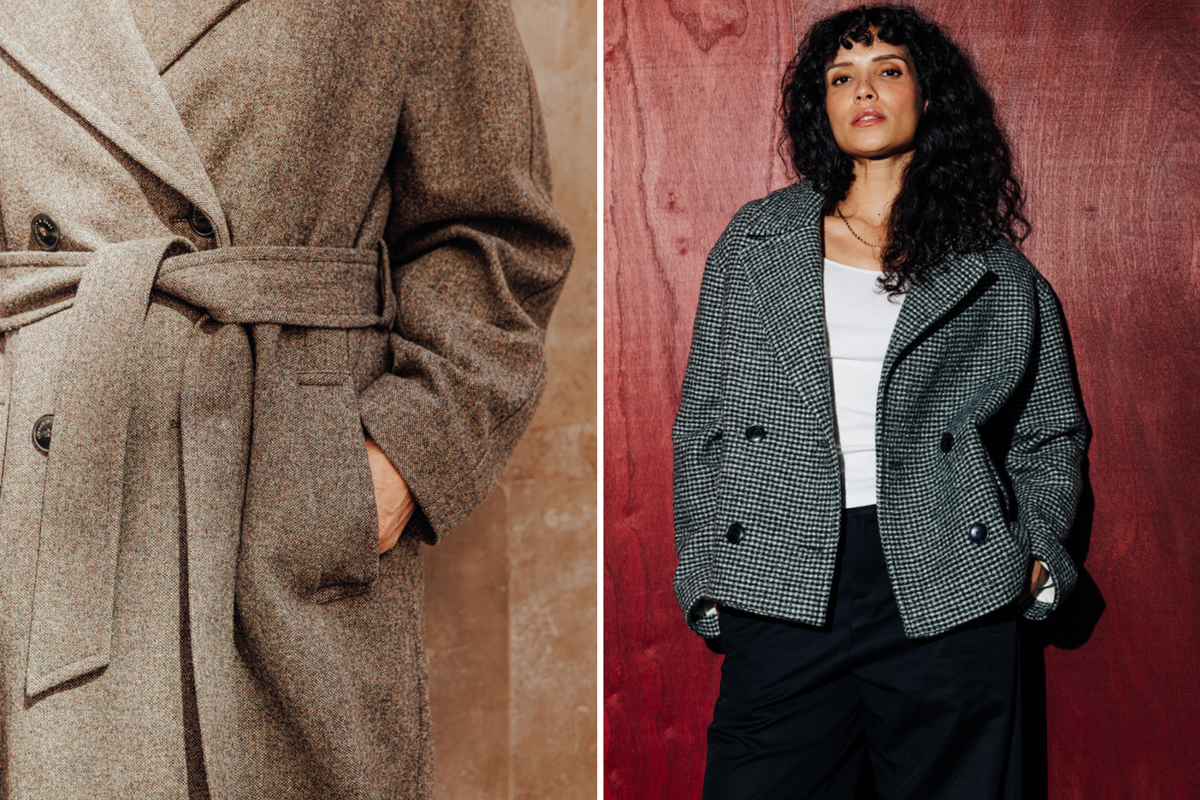

Which coat should you choose based on your body shape?
Body shape can be a good starting point for choosing a coat, provided you don't treat it as an absolute rule. A coat can simply complement your proportions, create a specific effect, or allow you to play with volumes.
To choose wisely, several elements should be considered together: the cut, the length, the construction of the shoulders, the volume of the garment, and how the waist is defined.
A single silhouette can thus be enhanced by several types of coats, depending on the desired effect.
| Silhouette or need | What usually works | What to watch out for | Trench & Coat advice |
|---|---|---|---|
| A-shape silhouette | Structuring the upper body and creating a balance between volumes | Very heavy volumes concentrated on the hips | Precieux coat |
| H-shape silhouette | Adding movement or subtly suggesting the waist | Very uniform cuts if you want more relief | Sequoia coat |
| X-shape silhouette | Complementing the waist and respecting natural proportions | Volumes that completely mask the line | Mably coat |
| Petite woman | Favoring controlled proportions | Lengths and volumes that can overwhelm the silhouette | Murier short coat |
| Tall woman | Playing with lengths and volumes | Proportions that are too short if you are looking for an elongated silhouette | Longtroene coat |
Understanding your body shape before choosing your coat
Style guides generally use several letters to describe the broad proportions of the female body.
The A-shape silhouette has a lower body line that is more prominent than the shoulders. The H-shape silhouette is characterized by relatively aligned shoulders and hips, with a subtle waist. The X-shape silhouette has balanced shoulders and hips with a more defined waist.
These categories are primarily visual benchmarks. They define neither a size, nor a build, nor a style. Two women with the same body shape can perfectly well wear very different coats.
To choose a coat, it is therefore more interesting to ask yourself: what proportions do I want to create?
Do you want to emphasize your waist? Add more structure to your shoulders? Visually elongate your silhouette? Or simply favor a comfortable coat that allows you to easily layer a sweater or jacket underneath?
These are the questions that allow you to choose a cut with greater precision.
Which coat to choose for an A-shape silhouette?
For an A-shape silhouette, the goal can be to create a balance between the upper and lower body.
Coats that add structure to the shoulders or collar can naturally draw the eye toward the top of the silhouette. A straight cut, sharp shoulder construction, or a well-defined tailored collar can create an interesting balance.
Length also deserves special attention. A relatively fluid line, without an accumulation of volume at the hips, helps to maintain a harmonious silhouette.
A belted coat can also be suitable, provided its volume is well distributed. The belt naturally draws attention to the waist and can complement the proportions rather than restrict them.
The workshop's tip: do not choose your coat solely based on your body shape. Observe, above all, where the volumes of the model are located: shoulders, bust, waist, and the bottom of the coat must work together.
Which coat to choose for an H-shape silhouette?
With an H-shape silhouette, the body line is relatively regular and the waist is not very defined.
Several options are possible depending on the desired effect. A straight cut can extend this natural line and create a very elegant and structured look.
Conversely, a belted coat can introduce more movement. The belt then helps to suggest the waist without completely transforming the proportions.
Supple materials are also interesting. They allow the coat to follow the movement rather than creating a silhouette that is too rigid.
An oversize volume can also work, provided it is controlled. The coat should then play with proportions rather than simply giving the impression of being too big.
The workshop's tip: if you want to create more relief, favor coats that combine volume and construction: a belt, a worked collar, or structured shoulders can be enough to change the perception of the silhouette.
Which coat to choose for an X-shape silhouette?
The X-shape silhouette is characterized by a balance between the shoulders and the hips, with a naturally defined waist.
Belted coats are particularly interesting when you want to complement this proportion. The belt highlights the waist while maintaining the overall structure of the garment.
But a straight cut can also be very elegant. It creates a cleaner line and avoids the need to systematically highlight the waist.
The choice therefore depends primarily on the desired effect. A belted coat will give a more defined look, while a straight cut will provide more simplicity and verticality.
Oversize can also be worn, especially if you want to break away from very fitted silhouettes. In this case, the quality of the pattern-making becomes essential: the volume must be intentional and proportioned.
The workshop's tip: an X-shape body type makes it easy to play with different constructions. The question is not about "hiding" or "showing" the waist, but about choosing the proportion that matches your style.
Which coat for a petite woman?
For a petite woman, the choice of length and volume can have more impact than the body shape itself.
A short or mid-length coat can help keep a visually light silhouette. A straight and vertical line can also contribute to giving an impression of continuity.
This does not mean, however, that a long or oversize coat is forbidden. On the contrary, a petite woman can perfectly well wear a long coat, provided its proportions are mastered.
The sleeve length, the position of the shoulders, the width of the collar, and the general volume must be consistent with your stature.
Layering should also be taken into account. A coat that is too fitted risks limiting the ability to wear a thick sweater underneath, whereas a slightly more generous volume can provide more comfort without necessarily weighing down the silhouette.
The workshop's tip: look at the coat as a whole rather than stopping at its length. A long model with a fluid line can be more flattering than a short but very voluminous coat.
Which coat for a tall woman?
A tall woman can more easily play with lengths and volumes.
A long coat allows you to take advantage of this verticality and create an elegant and continuous silhouette. Oversize volumes can also find their place naturally, especially when accompanied by beautiful shoulder construction or a sufficiently structured material.
The belted coat is another interesting possibility. On a long silhouette, a belt can create a break in the line and give more character to the outfit.
However, it is not necessary to systematically choose a very long coat. A short cut can, on the contrary, create an interesting contrast and highlight the natural proportions of the silhouette.
The workshop's tip: take advantage of your stature to experiment with proportions. A long coat, an oversize volume, or a structured short cut can each produce a very different look.
Is the coat length more important than body shape?
When wondering which coat to choose, we often think immediately of our body shape. Yet, the length can significantly change the result.
A short coat creates a more dynamic silhouette and draws more attention to the legs. A mid-length coat generally offers a compromise between practicality and elegance. A long coat creates a more continuous line and can give more presence to the silhouette.
The length must also be consistent with the cut.
A long straight coat will not have the same effect as a long belted coat. A short oversize coat will not produce the same silhouette as a long oversize one.
This is why it is better to think cut + length + volume rather than looking for a single ideal characteristic.
Which coat to choose when you are hesitating between several cuts?
If you like several coats, a few observations will help you make the difference.
Start by looking at the shoulders. They should be consistent with the model's construction and not create tension when you move.
Observe how the coat hangs when open and then closed. Some models make full sense once buttoned or belted, while others are designed to be worn more freely.
Also try the coat with the clothes you actually wear in autumn and winter. A coat may be perfectly fitted over a simple sweater and become much less comfortable with a thicker knit.
Finally, look at yourself in motion. Walk, sit down, cross your arms. The coat should accompany your movements without losing its line.
It is often at this moment that one truly understands the quality of a cut.
Body shape and quality: the cut isn't everything
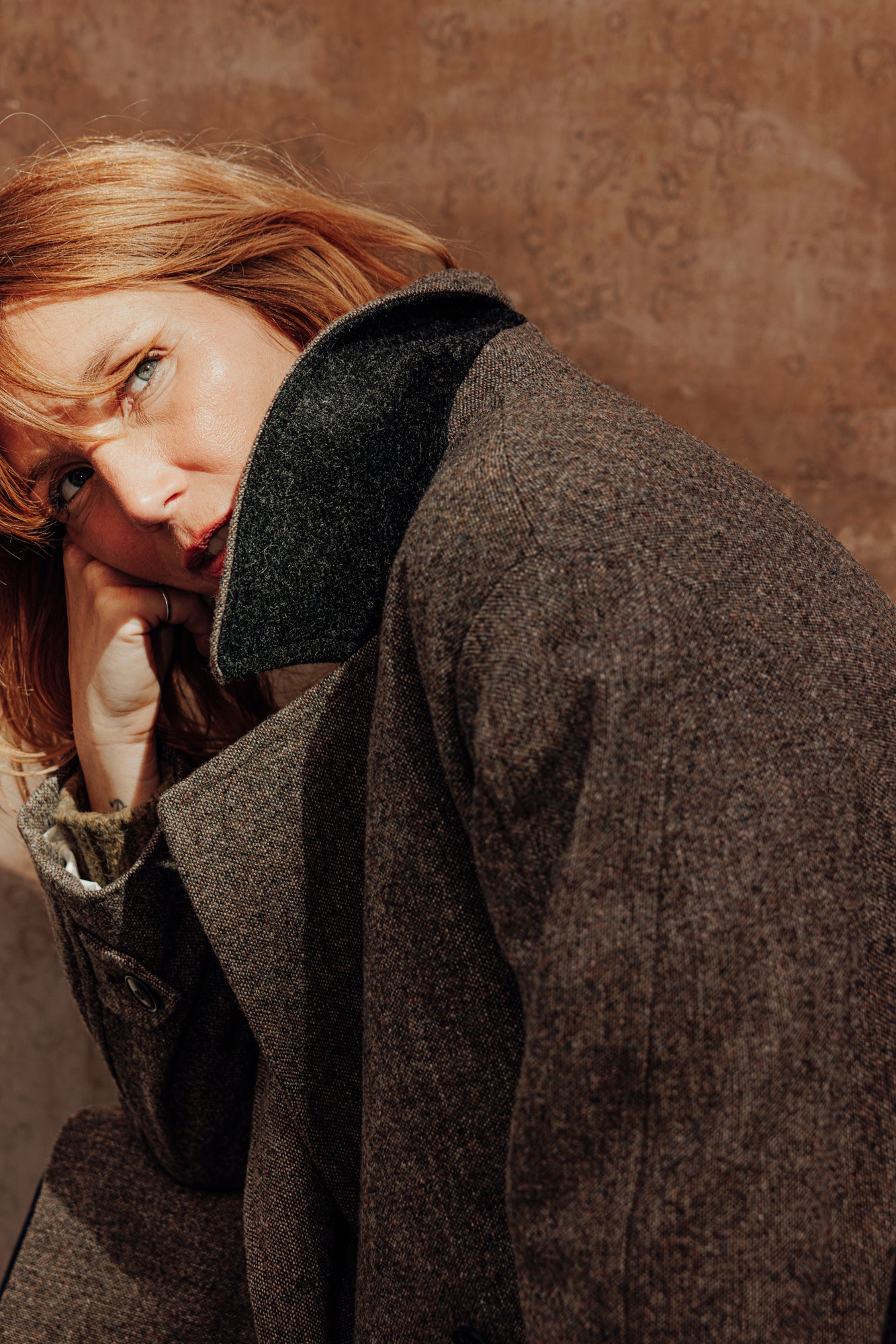
A good cut does not depend solely on the exterior design of the coat. It relies on a set of technical choices: pattern-making, material, shoulder construction, pocket placement, sleeve length, lining, and finishing.
A supple and fluid material will not react like a denser wool drape. A dropped armhole will not give the same movement as a set-in sleeve. A belt will change the silhouette, but also the way the fabric distributes itself around the body.
This is why the quality of a coat can be read as much in its interior as in its outward appearance.
To go further, discover our guide to recognizing a quality coat and the elements to observe before investing in a piece that you will wear for several seasons.
The work on the cut begins in the workshop
At Trench & Coat, the search for the right proportion begins long before the coat arrives in your wardrobe.
The model is first drawn in-house, then translated into a pattern. Prototypes are then made and adjusted to check the cut, volumes, and how the garment behaves.
This step is particularly important for a coat: a difference of a few centimeters on a shoulder, a sleeve, or a length can completely change the silhouette.
The pattern-making work thus allows a stylistic intention to be transformed into a wearable, comfortable, and coherent piece.
To discover the different steps that allow going from the idea to the final model, find the secrets of manufacturing a coat.
So, which coat should you choose based on your body shape?
There is no coat reserved for a single body shape.
An A-shape silhouette can play on shoulder structure and volume balance. An H-shape silhouette can choose between a straight line or a cut that introduces more movement. An X-shape silhouette can highlight its waist with a belt or prefer a cleaner line.
For petite women, mastering proportions is essential, while tall women can more easily play with lengths and volumes.
But in all cases, body shape should remain only a reading tool.
The best coat is the one whose cut matches your style, whose proportions please you, and in which you can actually move and layer the clothes you need.
That is ultimately where the difference lies between a coat simply chosen for its appearance and one that is truly well-chosen: it must work on you, not just on a hanger.